TWR, APP, ACC
Air Traffic Control
The Polish Air Navigation Services Agency (PANSA) is an institution that provides air navigation services and is also an essential element of the country’s critical infrastructure. It is one of the key units for ensuring the safety of air traffic.
Air traffic control is divided into three main areas: area control service (ACC – Area Control Centre), approach control service (APP – Approach Control Service) and airport control service (TWR – Aerodrome Control Tower). Each of these has the responsibility of managing aircraft at different stages of their journey.
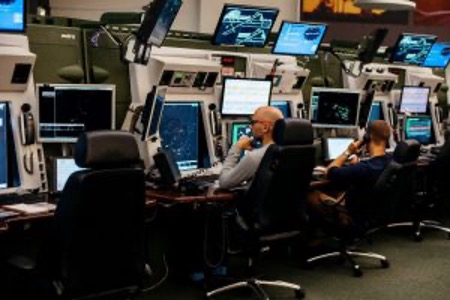
TWR personnel work in the operational rooms of control towers located throughout Poland. From the towers and rooms, they can observe both landing and taxiing aircraft. Controllers working in area control and approach control do not need visibility of taxiways or runways. Their primary task is to ensure adequate separation between aircraft in the air. For these personnel, radar imaging and radio communication with aircraft crews are crucial for performing their daily tasks. Technically, the operational rooms of approach and area control do not need to be in the same buildings as the tower controllers. Their workspaces are isolated from external noise, where operational staff focus on managing air traffic flows and ensuring the safety of aircraft flying overhead.
ACC
To introduce the area control service (ACC), let’s first discuss airspace structure. The Airspace Information Region (FIR) is airspace extending from the ground to a specific altitude and limited horizontally. In Poland, there is one FIR, extending up to about 22 km, with its boundaries covering the eastern, southern, and western borders of Poland and extending into part of the Baltic Sea to the north. The FIR shape typically reflects the geographical shape of the country, although this is not always the case, especially in larger countries, which may have several regional FIRs. Smaller countries may share a central FIR.
The airspace within the Warsaw FIR is divided into several sectors. Since March 2016, each sector at an altitude of around 11 km has been split into upper and lower sectors. The configuration of sectors is flexible and depends on operational factors, so some sectors may be combined into pairs or groups. The primary goal is ensuring air traffic safety, with each part of the airspace being managed by different controllers – usually in pairs, as ACC controllers work in teams.
Around airports, there are controlled airport regions (TMA) and controlled airspace zones (CTR), where approach and tower controllers manage air traffic. Aircraft flying from city A to city B exit the TMA via a gate and then switch to the appropriate ACC frequency for the sector they are in. They typically request clearance to continue climbing to cruising altitude, and the controller grants this to ensure safety for all air traffic participants. Alternatively, the aircraft may gradually climb, staying at a lower cruising level for some time or slightly deviating from the planned route to facilitate smooth climbing to the assigned cruising altitude.
Typical cruising altitudes (FL240 to FL400, or 7 to 12 km) are determined based on the aircraft type, capabilities, and flight route. These altitudes are calculated during the flight planning phase, taking into account the economy of flight and operational factors. During the flight, the aircraft crosses multiple sectors and sometimes FIRs, switching frequencies and following ACC controllers’ instructions. Pilots prefer to maintain their cruising altitude and continue on it until reaching the Top of Descent (TOD), which is the point at a specific distance from the destination airport when descent should begin. TOD depends on the aircraft’s speed, altitude, and the optimal (safe and comfortable) descent rate. As the aircraft descends, it reaches the entry gate to the TMA of the destination airport, where the crew receives instructions to contact the appropriate APP or TWR service.
This process may seem straightforward, but in reality, area control service is very demanding. Remember, at any given time, a sector may have aircraft flying in various directions at different cruising altitudes. They may be maintaining different speeds, often affected by wind, and their flight paths often intersect. Sometimes, crews request to avoid areas of dangerous atmospheric phenomena or ask for shortcuts to save time and distance. It is also common for pilots to request altitude changes due to turbulence or for better performance. Keep in mind that each higher cruising altitude is about 305 meters above the previous one, but in a busy area like Warsaw, it is difficult to maintain a constant altitude, especially when aircraft are only a few kilometers apart. This requires constant coordination among controllers across sectors to ensure each aircraft remains at a safe distance from other traffic.
Area control controllers work in highly dynamic and stressful conditions. This is especially true for lower sectors, where aircraft are less predictable. There is a challenge in directing flights at lower altitudes to reduce workload during busy times, so controllers must remain alert at all times to ensure the safety of each aircraft.
APP
The approach control service (APP) serves as a buffer between the area control service (ACC), which manages flights at cruising altitudes, and the airport control service (TWR), which organizes air traffic at airports and in their vicinity.
Aircraft descending from cruising altitude and preparing to land gradually lower their altitude until they reach the proper height and a specific geographical point. This point is the entry gate to the TMA. At that point, crews switch their radio to the local APP frequency or directly to TWR if radar-based APP control is not provided. In the latter case, TWR controllers also perform the role of approach controllers, though without using radar imagery (this is known as procedural control, where tower controllers monitor the aircraft’s position based on crew reports).
Radar-based approach control is particularly needed in TMAs with higher traffic volumes of IFR flights within controlled airspace. Radar control starts from a few hundred meters above ground, which is determined by regulations for each TMA. As the name suggests, TMA is a controlled area around an airport, meaning it does not include training or tourist aircraft flying below the specified height. For APP, these aircraft are only relevant if they want to fly higher and enter controlled airspace.
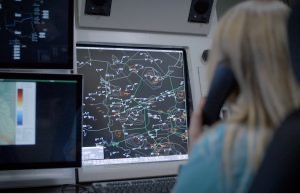
APP’s job is to maintain safe separation between landing aircraft, queue them before handing them off to TWR, and separate them from departing aircraft. This is done dynamically, with radar imagery and frequent voice communication instructions. These operations require close cooperation with TWR, ACC, and other units, so APP positions are equipped with communication panels for immediate internal communication (similar to other air traffic control positions). Coordination among services and units is crucial for the smooth and safe management of air traffic.
Why is approach control so important at busy airports? Again, let’s use Warsaw Chopin Airport as an example. During peak traffic, takeoffs and landings occur every two minutes. This means there is heavy congestion in the airspace of the Warsaw TMA.
Imagine several aircraft preparing to land simultaneously. Of course, they are still tens or even over a hundred kilometers away from the runway threshold, flying at different speeds and altitudes. These aircraft have different designs, engines, and capabilities, affecting their flight and altitude changes. Approach controllers must ensure that these aircraft are smoothly brought to the approach path in the correct order and with safe distances between them, maintaining lateral and vertical separation. The aircraft must also maintain the correct altitude and, after the final turn, the correct direction to capture the ILS (Instrument Landing System) signal, depending on the type of approach.
Organizing arriving aircraft is only half the job. In the meantime, departing aircraft are also taking off and heading in various directions. Pilots communicating with APP controllers shortly after takeoff expect to climb smoothly to their cruising altitude and proceed on their planned route without unnecessary delays. It is the controller’s responsibility to maintain safe distances between arriving and departing aircraft flying in different directions, changing altitudes up or down. Once a departing aircraft reaches the TMA boundary, the crew is instructed to switch to the area control service frequency for the next stage of their flight.
APP controllers in Warsaw work at the Air Traffic Management Centre of the Polish Air Navigation Services Agency. Their area of responsibility also includes Modlin Airport and arrivals and departures from several smaller nearby airports. Similarly, radar-based approach control is provided in Gdańsk, Kraków, Katowice, Poznań, and Wrocław.
TWR
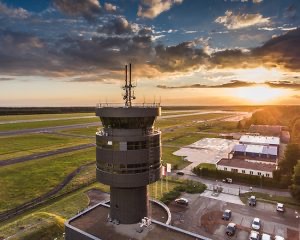
Operational staff in airport control service (TWR) usually work in towers that are high enough to allow them to observe both the maneuvering area and the airspace around the airport.
It is possible (and not uncommon) that an unauthorized aircraft or a ground service vehicle may enter a runway, or an animal may be on it. A flock of birds could gather near the landing point. In each such case, the tower controller must react swiftly to counter the threat. The view from the airport allows the controller to assess whether an incoming aircraft can be cleared to land or if it should be sent to the go-around procedure. Regardless of their specific role during the shift, tower controllers must ensure the safety of departing, arriving, and taxiing aircraft.
In simple terms, tower controllers ensure air traffic safety at “their” airport. Depending on the organization of airspace and radar control around the airport, their area of responsibility may vary. This depends on whether the airport is served by an approach control service (APP). This is mainly determined by safety considerations and the volume of passenger operations. When traffic is high, approach controllers help manage the air traffic in the controlled airport area (TMA). A TMA is a portion of airspace with a defined radius (e.g., 100 km) from the airport and limited to a specific altitude (e.g., around 3–4 km or higher). It serves as a buffer between area control services (ACC) and the airport itself. Where there is a separate approach control service, an aircraft is monitored by approach controllers on radar from the moment it enters the TMA until it stabilizes for approach. This usually happens at altitudes of 1–2 km, several kilometers from the runway threshold. At this point, the crew is instructed to switch to the TWR frequency – and it is from the tower that the pilot will receive landing clearance or instructions for a go-around.
In a TMA without a separate approach control (for example, in Lublin or Olsztyn), tower controllers’ work starts at the entry gate to the TMA. The area control service then instructs the incoming crew to establish direct communication with the tower. The TWR controller must continuously monitor the aircraft’s position, relying on accurate position and time reports from the crew.
In the opposite direction, the process follows a similar sequence but in reverse order. The TWR service ends immediately after an aircraft’s takeoff if there is an APP service at the airport. Otherwise, the tower controllers’ responsibility extends all the way to the TMA boundary.
Let’s look at how this works in Warsaw. Warsaw Chopin Airport is the largest and busiest airport in Poland. Therefore, the workload is significant, especially during peak times. Air traffic density is higher several times a day. In most cases, aircraft are handed over from approach to TWR communication while on the approach path and at a safe distance from each other. TWR controllers must ensure that arriving aircraft can safely land before giving the crew clearance. It’s important to remember that, alongside landing aircraft, there is a queue of planes ready for takeoff on the maneuvering area. TWR controllers must skillfully alternate between takeoffs and landings while maintaining all safety procedures. It’s also worth noting that TWR controllers’ duties don’t end with landing and takeoff clearance. They are also responsible for managing air traffic in the airport’s vicinity, which is increasingly intersected by small training, tourist aircraft, and helicopters.
TWR controllers are also responsible for providing aircraft crews with formal clearances and essential information. They also coordinate ground traffic. The airport’s maneuvering area is not only for aircraft but also for many vehicles, which sometimes need to occupy paths typically reserved for taxiing aircraft.
Now, here’s an interesting fact. It’s not always the case that tower controllers work directly in the tower. The global solution known as remote towers allows for operational rooms located away from the served airports, where TWR controllers rely on images from multiple cameras. They are equipped with high-quality audiovisual equipment, ensuring top-notch images of the approach path, runways, and maneuvering area. Thanks to this, they can see on their screens what they would normally see through a window.