ARCC
Poland was obliged to establish ASAR by international provisions, including the 1944 Convention on International Civil Aviation. It is one of the rescue services that has been operating in our country for a long time, but as part of different institutions and in changed structures.
ASAR’s task is to search for aircraft that may be in danger, as well as to help passengers, crews and other people that suffered in result of various air accidents. Neither the nationality nor the origin of the aircraft matters. The service is provided to all those in need within the borders of the Polish FIR, although of course it is provided in cooperation with international partners if needed.
On January 25, 2018, the Civil-Military Search and Rescue Coordination Center (ARCC) was launched as part of Polish Air Navigation Services Agency. Its task, as indicated in its name, was to coordinate rescue tasks, which was previously performed solely by military entities.
ARCC
The ARCC is now composed of three elements:
- the RCC, which serves as a coordination center, located at the headquarters of PANSA and acting as a command element,
- ARSC sub-centre in Warsaw,
- ARSC sub-centre in Gdynia.
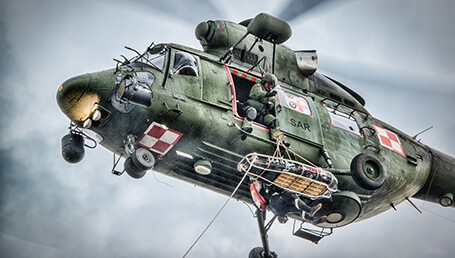
The ARCC has at its disposal the Aviation Search and Rescue Teams (LZPR) deployed in seven locations across Poland, which mainly operate helicopters and aircrafts.
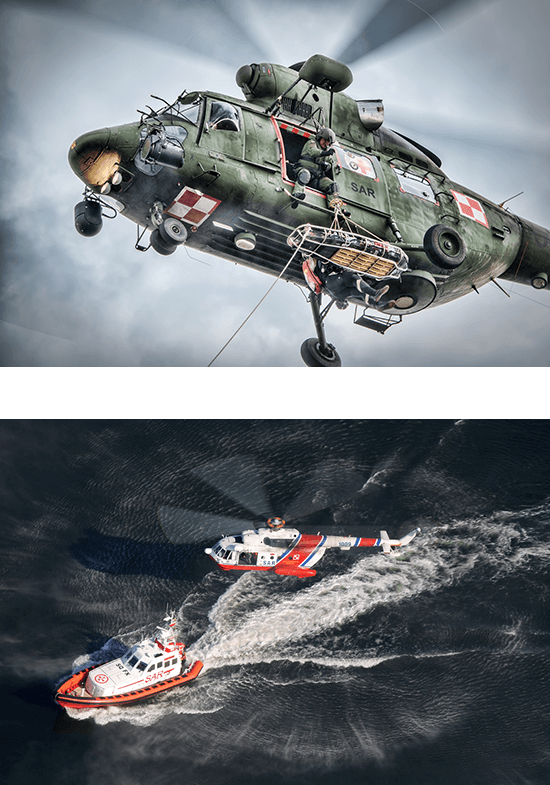
The RCC Coordinators are on duty 24 hours a day. They are professionals experienced in air traffic services, who know and understand the specificity of operational work. The team consists of civilian and military personnel. The service remains in constant readiness to provide assistance to potential victims of air accidents. They also conduct 24h supervision of the of assets delegated to serve under ASAR. Coordinators constantly improve their qualifications by taking part in trainings, conferences or meetings with representatives of institutions and organisations responsible for state security.
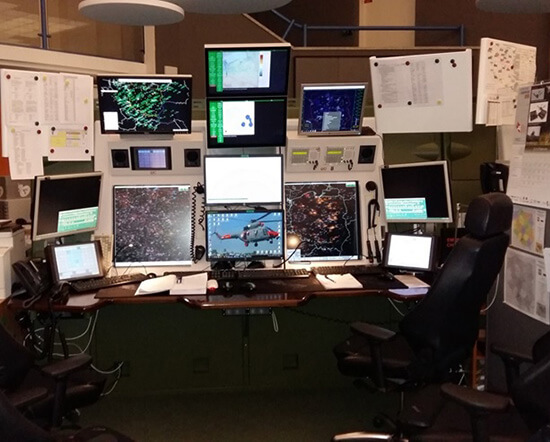
RCC coordinators perform their everyday service in the operating room of the Air Traffic Management Centre at PANSA. Therefore, they work closely with various air traffic services, as well as a shift manager who collects information from all over Poland about all incidents and unusual situations. This close cooperation and short decision-making process is key in emergency operations. Information about the event can be sent to the RCC team by air traffic services, and vice versa – Coordinators can receive such a message from the outside and pass it on to the Shift Manager.
The RCC coordinators’ station resembles the workspace of other air traffic service employees. It is equipped with monitors showing the sky situation and weather information. Systems such as PANDORA, CAT or the AFTN network are available to facilitate the work and provide additional information. Above all, however, various communication systems are used in the work. The RCC uses VCS radio communication panels set up to monitor the emergency frequency and enable rapid alerting of key search and rescue units and institutions in Poland.
RCC coordinators monitor and respond to all emergency signals on a daily basis, receiving, analysing and clarifying all data received, verifying its authenticity. They liaise with both air traffic services and aviation organisations, including the Civil Aviation Authority. Decisions to launch
a search and rescue operation are made on the basis of the information received, flowing into the RCC from various sources. The actions themselves are carried out in close cooperation with entities authorised to carry out search and rescue activities, such as the Air Rescue, MOPR, WOPR, TOPR, the military – including the Territorial Defence Forces, the Police, Border Guard and the Maritime Search and Rescue Service. In general, the ARCC can use the air, land and sea forces and resources that are available on a daily basis to the national search and rescue systems operating within the various institutions. The legislation also extends these powers to include the possibility of using civilian aircraft crews. However, all actions are guided by the guiding principle that the rescuer must be safe for those carrying out the rescue. Co-ordinators may therefore ask pilots to support the search, but must expect a refusal, e.g. due to the low operational capacity of the aircraft concerned. Fortunately, experience shows that one can usually count on the solidarity and assistance of other airmen.
Contact data:
Address:
Polska Agencja Żeglugi Powietrznej
ul. Wieżowa 8
02-147 Warsaw, Poland
Phones:
+48 22 574 51 90
+48 22 574 51 91
+48 885 745 190
Fax: +48 22 574 51 99
E-mail: arcc@pansa.pl
AFTN: EPWWYCYX
Logo