


Flights in open category
RULES FOR PERFORMING FLIGHTS IN THE OPEN CATEGORY
Operations in the “open” category (OPEN) allow low-risk flights. These include VLOS flights performed for both “commercial” and “recreational” purposes. However, the obligation is to register the Operator of a drone equipped with a camera and/or heavier than 250 g on the website drony.gov.pl, have appropriate competences (e.g. familiarization with the operating manual or have a certificate of completion of free training) and report each flight in the DroneTower mobile app.
Basic information
Operations in the “open” category may be performed only within the visual range of the pilot or an observer standing next to the pilot, up to a height of no more than 120 meters from the nearest point of the earth’s surface, with drones weighing not more than 25 kg.
The “open” category is divided into three subcategories: A1, A2 and A3, based on the operational restrictions and requirements to be met by unmanned aircraft system (UAS) as well as drone pilots:
- A1 – Flying over bystanders is permitted (with certain restrictions), but flying over assemblies of people is not allowed.
- A2 – You must not fly over people or assemblies of people. The minimum horizontal distance from people is 30 m or 5 m if the drone has a flight speed limiting function;
- A3 – You must not fly over people or assemblies of people. The minimum horizontal distance from residential, commercial, industrial or recreational areas is 150 m. “Assemblies of people”: gatherings in which the density of people prevents their movement.
Drones with which you can perform operations in the “open” category
Drones with which operations can be performed in the “open” category must meet the following conditions:
- to perform flights based on the provisions of Article 20 of COMMISSION IMPLEMENTING REGULATION (EU) 2019/947 of 24 May 2019 on the rules and procedures for the operation of unmanned aircraft;
- to belong to one of the “C” classes defined in COMMISSION DELEGATED REGULATION (EU) 2019/945 of 12 March 2019 on unmanned aircraft systems and on third-country operators of unmanned aircraft systems or are constructed for personal use;
- Have a takeoff weight of less than 25 kg.
Other requirements of the “open” category can be found in Article 4 of COMMISSION IMPLEMENTING REGULATION (EU) 2019/947 of 24 May 2019 on the rules and procedures for the operation of unmanned aircraft and Guideline No. 7/2024 of the President of the Civil Aviation Authority dated May 20, 2024.
Operator registration
An operator of an unmanned aircraft system could be compared to an airline that owns many planes but does not fly them themselves. It is done by pilots who acquire the required ratings to fly the aircraft during courses and training. It’s very similar in unmanned aviation community.
European drone regulations have made it mandatory to register operators, i.e. individuals or legal entities (e.g. companies, public institutions) that “intend to operate at least one unmanned aircraft system.”
Mandatory operator registration is subject to:
- in case the weight of the drone is 250 g or more, or in the case of a drone that can transfer kinetic energy of more than 80 joules to a human during impact;
- in case the drone is equipped with a sensor capable of collecting personal data (e.g., a camera), unless the drone which is intended for children under the age of 14 according to DIRECTIVE 2009/48/EC OF THE EUROPEAN PARLIAMENT AND OF THE COUNCIL of 18 June 2009 on the safety of toys.
This means that the requirement to register as an operator does not apply to us when we intend to fly:
- a toy;
- a drone lighter than 250 g (or one that can impart kinetic energy of less than 80 joules to a human on impact) and is not equipped with a camera.
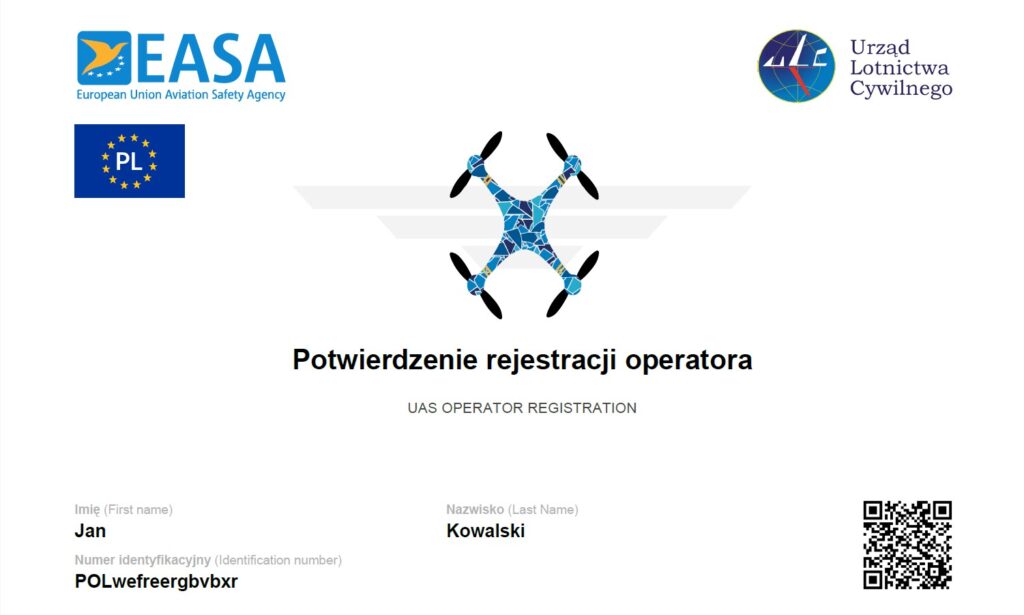
After free registration at https://drony.gov.pl/, you will receive a Confirmation of Operator Registration with a unique identification number assigned. This number should be placed on each drone for which registration is required.
IMPORTANT! The operator does not have to fly the drone at all. They could be, for example, simply be the owner. In addition to the obligation to register, that person also has liabilities as an operator of an unmanned aircraft system as described in Section UAS.OPEN.050 of COMMISSION IMPLEMENTING REGULATION (EU) 2019/947 of 24 May 2019 on the rules and procedures for the operation of unmanned aircraft.
Every drone that is not a toy and is equipped with a camera should display the operator’s number, for whom the pilot is flying.
Pilot competencies required to fly in the “open” category
To fly a drone independently, it is requided to be at least 16 years old and have the necessary competency.
- it is necessary to have knowledge of UAS manual in case of the lightest UAS (<250 g),
- in case of heavier drones (>250 g), it is necessary to complete a free online training course (https://drony.gov.pl/) and then pass a free online exam of theoretical knowledge confirming competence to fly in the A1 and A3 subcategories.
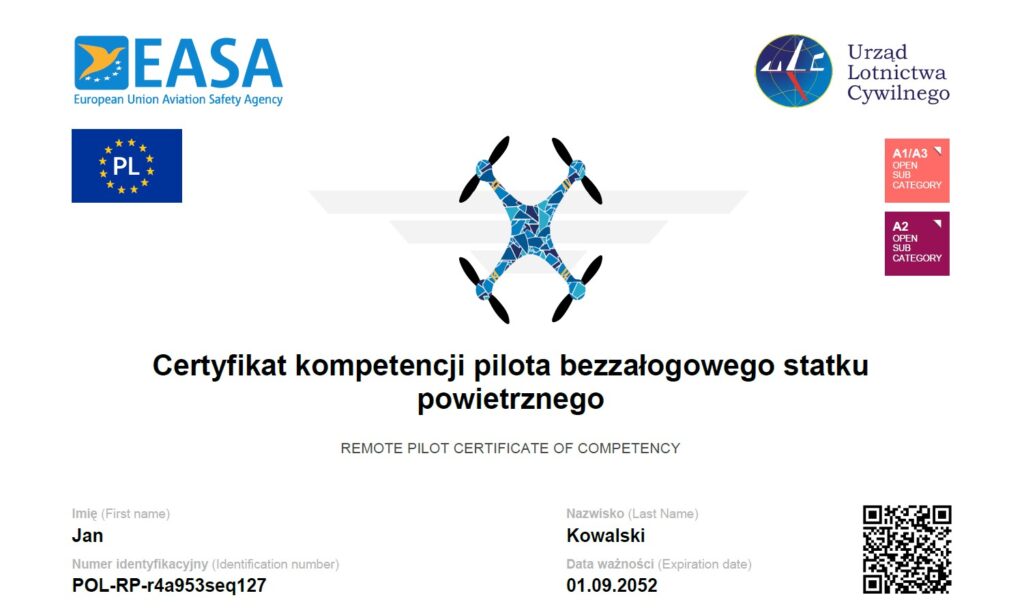
It is worth mentioning that passing the training and passing the exam for the A1 or A3 subcategory does not mean that the pilot has complete freedom to fly a drone. For example, a light drone (<250 g) is permitted to fly over bystanders if necessary, something we are not allowed to do with a heavier drone under normal circumstances.
Acquiring A2 subcategory flying competency allows you to fly C2 class drones.
Operations that cannot be carried out under subcategory A1 or A2 must be carried out in accordance with the conditions specified for subcategory A3. This means flying within 150 meters horizontally of built-up, industrial or recreational areas, and ensuring that flights do not pose a danger to bystanders.
Limitations of the “open” category
The “open” category was created for low-risk flights. This means that there are limitations associated with it. The most important of these are:
- the need to maintain the required distances from persons and buildings specified in the provisions of COMMISSION IMPLEMENTING REGULATION (EU) 2019/947 of 24 May 2019 on the rules and procedures for the operation of unmanned aircraft,
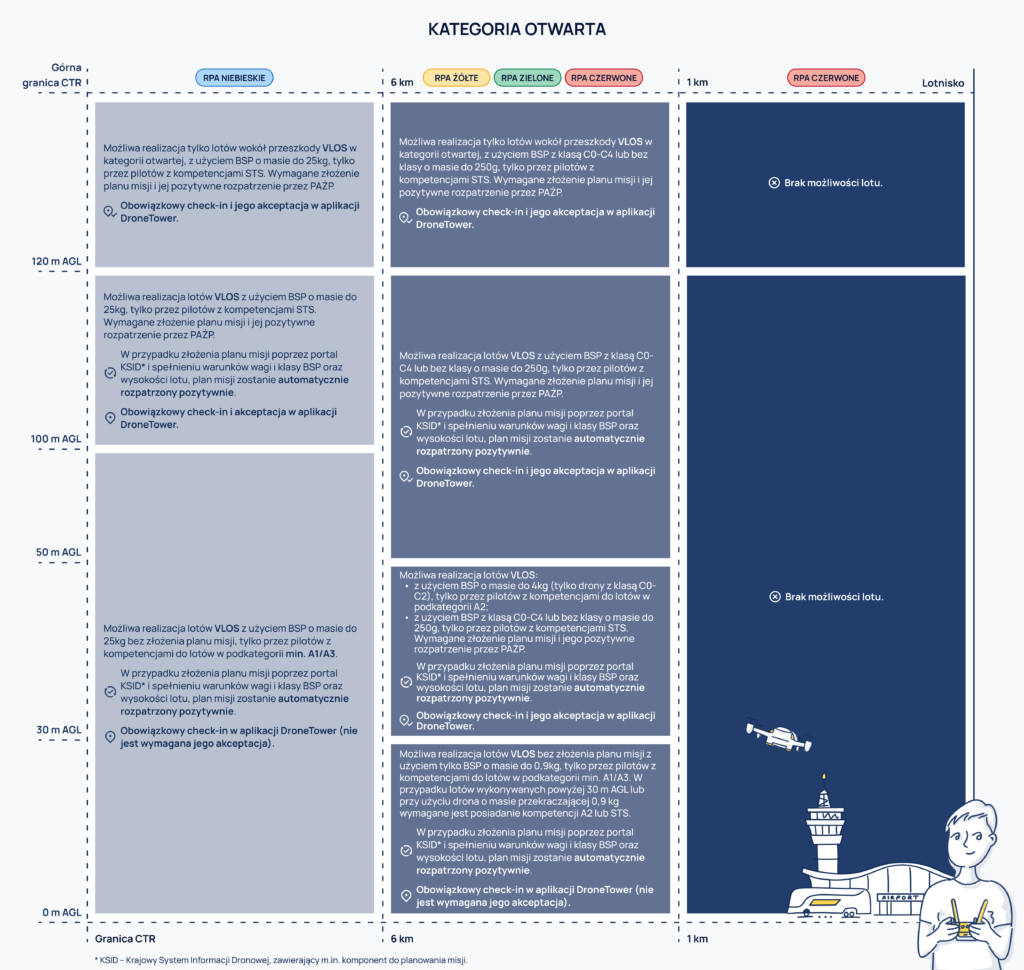
- inability to fly in DRA-RL CTR zones < 1KM located 1 km from controlled communication airports,
- inability to fly in DRA-RM/RH CTR zones without competency at minimum level A1/A3,
- inability to perform flight at altitude > 30 m AGL in DRA-RM CTR zones <6KM located 1 -6 km from controlled communication airfields without competency at minimum level A2,
- inability to perform flight at altitude > 50 m AGL in DRA-RM CTR zones <6KM,
- inability to fly at altitudes > 100 m AGL in DRA-RH CTR zones located more than 6 km from controlled communication airports.
Legal basis
COMMISSION IMPLEMENTING REGULATION (EU) 2019/947 of 24 May 2019 (consolidated version of 4 April 2022) on rules and procedures for the operation of unmanned aircraft;
COMMISSION DELEGATED REGULATION (EU) 2019/945 of 12 March 2019 (consolidated version of 9 August 2020) on unmanned aircraft systems and third-country operators of unmanned aircraft systems;
Act of 3 July 2002 – Aviation Law (Journal of Laws of 2023, item 2110; of 2024, items 731 and 1222; and of 2025, items 31 and 179).
Act of 8 December 2006 on the Polish Air Navigation Services Agency (Journal of Laws of 2024, item 1272, and of 2025, items 179)
Guideline No. 7/2024 of the President of the Civil Aviation Authority of 20 May 2024 on the methods of conducting operations using unmanned aircraft systems in connection with the entry into force of the provisions of Commission Implementing Regulation (EU) No 2019/947 of 24 May 2019 on rules and procedures for the operation of unmanned aircraft systems.
Guideline No. 4/2025 of the President of the Civil Aviation Authority of 21 February 2025 on the designation of geographical zones for unmanned aircraft systems.